
Zoobooks magazine for kids!
Advertisement.

EnchantedLearning.com is a user-supported site.
As a bonus, site members have access to a banner-ad-free version of the site, with print-friendly pages.
Click here to learn more.

Become a member of Enchanted Learning.
Site subscriptions last 12 months.
Click here for more information on site membership.

$20.00/year or other amount
(directly by Credit Card)

$20.00/year or other amount
(via PayPal)

$20.00/year or other amount
(for sending a check by mail)

$20.00/year or other amount
(for subscribing by school purchase order)
As a thank-you bonus, site members have access to a banner-ad-free version of the site, with print-friendly pages.
(Already a member? Click here.)

Zoom Astronomy
The Stars
Lifecycle Nuclear Fusion Brightest Stars Galaxies Other Solar Systems Constellations Why Stars Twinkle
Birth Death Star Types Closest Stars Nebulae Major Stars The Zodiac Activities, Links

The Birth of Stars The Death of Stars
Sun-like Stars
(Up to 1.5 times the mass of the Sun)
Huge Stars
(From 1.5 to 3 times the mass of the Sun)
Giant Stars
(Over 3 times the mass of the Sun)

THE DEATH OF SUN-LIKE STARS
(with a mass up to 1 1/2 times that of the Sun)


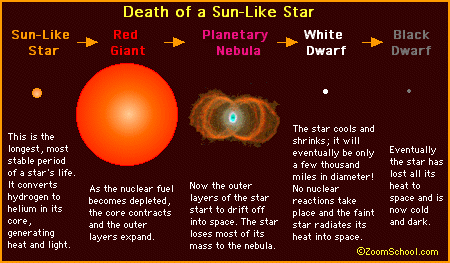
A stars expands as it grows old. As the core runs out of hydrogen and then helium, the core contacts and the outer layers expand, cool, and become less bright; this is a red giant.

After expanding and reaching the enormous red giant phase, the outer layers of the star continue to expand. As this happens, the core contracts; the helium atoms in the core fuse together, forming carbon atoms and releasing energy. The core is now stable since the carbon atoms are not further compressible.


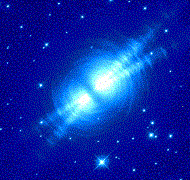
The Egg nebula: a planetary nebula formed a few hundred years ago.
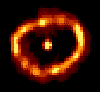
Now the outer layers of the star start to drift off into space, forming a planetary nebula (a planetary nebula has nothing to do with planets).

The star loses most of its mass to the nebula. The star cools and shrinks; it will eventually be only a few thousand miles in diameter!


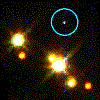
A White dwarf star: (circled) in the globular cluster M4.
The star is now a white dwarf, a stable star with no nuclear fuel. It radiates its left-over heat for billions of years. When its heat is all dispersed, it will be a cold, dark black dwarf - essentially a dead star (perhaps replete with diamonds, highly compressed carbon).

NOVA
A nova is a white dwarf star that suddenly increases in brightness by several magnitudes. It fades very slowly.


Enchanted Learning®
Over 20,000 Web Pages.
Sample Pages for Prospective Subscribers

Overview of Site
What's New
Enchanted Learning Home
Monthly Activity Calendar
Books to Print
Site Index

K-3
Crafts
K-3 Themes
Little Explorers
Picture dictionary
PreK/K Activities
Rebus Rhymes
Stories
Writing
Cloze Activities
Essay Topics
Newspaper
Writing Activities
Parts of Speech

Fiction
The Test of Time
Biology
Animal Printouts
Biology Label Printouts
Biomes
Birds
Butterflies
Dinosaurs
Food Chain
Human Anatomy
Mammals
Plants
Rainforests
Sharks
Whales
Physical Sciences
Astronomy
The Earth
Geology
Hurricane
Landforms
Oceans
Tsunami
Volcano
Languages
Dutch
French
German
Italian
Japanese (Romaji)
Portuguese
Spanish
Swedish
Geography/History
Explorers
Flags
Geography
Inventors
US History

Other Topics
Art and Artists
Calendars
Crafts
Graphic Organizers
Label Me! Printouts
Math
Music

Click to read our Privacy Policy

E-mail


Enchanted Learning Search

First search engine with spelling correction and pictures!
Search EnchantedLearning.com for all the words:
Enter one or more words, or a short phrase.
You can use an asterisk * as a wild-card.


Advertisement.


Advertisement.


Copyright ©1999-2008 EnchantedLearning.com ------ How to cite a web page