

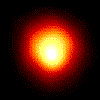


Stars expand as they grow old. As their core runs out of hydrogen and then helium, the core contacts and the outer layers expand, cool, and become less bright. This is a red giant or a red super giant (depending on the initial mass of the star). It will eventually collapse and explode. A star’s life span and eventual fate are determined by the original mass of the star.
Life span
The most massive stars have the shortest lives. Stars that are 25 to 50 times that of the Sun live for only a few million years. They die so quickly because they burn massive amounts of nuclear fuel.
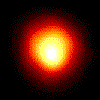
Betelgeuse
For example, Betelgeuse (the second-brightest star in Orion) is a red supergiant star that is about 20 times more massive than the Sun. It is about 14,000 times brighter than the Sun and burns nuclear fuel at a rate 14,000 times faster than than that of the Sun. The Sun will live about 7,000 times longer than a massive star like Betelgeuse.
Stars like our Sun live for about 10 billion years. Stars less massive than the Sun have even longer life spans.
Fate of a star
A star will become either a black dwarf, neutron star, or black hole, depending on how massive it was. .
Sun-like stars (under 1.5 times the mass of the Sun)
→ Red Giant → Planetary Nebula → White Dwarf → Black Dwarf
Huge stars (1.5 to 3 times the mass of the Sun)
→ Red Supergiant → Supernova → Neutron Star
Giant stars (over 3 times the mass of the Sun)
→ Red Supergiant → Supernova → Black Hole
Evolved star
An evolved star is an old star that is near the end of its existence. Its nuclear fuel is mostly gone. The star loses mass from its surface, producing a stellar wind (gas that is ejected from the surface of a star). Older stars produce more stellar wind than younger stars.