
|
| Table of Contents | Enchanted Learning All About Astronomy |
Site Index |
| Our Solar System | Stars | Glossary | Printables, Worksheets, and Activities | ||||||
| The Sun | The Planets | The Moon | Asteroids | Kuiper Belt | Comets | Meteors | Astronomers | ||
| Zoom Astronomy Questions and Answers (November 2001) |  |
 |
Please check the Astronomy Dictionary first!
We enjoy hearing from visitors. Thank you for writing! You can send us your astronomy question and we'll try to answer as soon as possible (but we can't answer all the questions we receive).
|
| Zoom Astronomy Questions |
|---|
| Current Questions | November 2001 | October 2001 | September 2001 | August 2001 | June-July 2001 | May 2001 | April 2001 | March 2001 |
A: A pulsar is a rapidly spinning neutron star that emits energy in pulses. Pulsars were named for their pulsing emissions. For more information on pulsars, click here.
A:
See the glossary entries for MACHO, blue shift and space trash.
A: Probably.
A: Hydrogen is the primary fuel of stars (it releases energy in a nuclear process called fusion).
A:
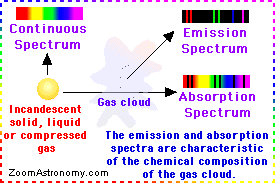
Astronomers can determine the composition of gases in stars by looking for characteristic frequencies in their spectral emissions (they look at the light given off by the star of the light that passes through a nebula).
A: We experience a meteor shower when the Earth goes through the bits of debris left from a comet - some of the debris falls to the Earth, burning up in our atmosphere. The Leonid meteor shower we just saw was from rubble left over from the comet Temple-Tuttle.
A: Comets go around the Sun in very elliptical orbits (shaped like squashed circles). We can only see a comet when it is near the Sun (most of the time, it is far from the Sun and invisible to us. For more information on comets, click here.
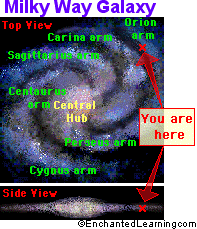
A: Click here for information on the Milky Way Galaxy.
A: See the page on the Sun.
A: The Earth's sky looks blue because the gas molecules in the atmosphere scatter the higher-energy (high frequency) blue portion of the sunlight more than they scatter the lower-energy red portion of the sunlight (this is called Raleigh scattering, named for the physicist Lord John Rayleigh). On Mars, there are a lot of fine dust particles suspended in the atmosphere. These particles (which contain a lot of iron oxide) absorb blue light, so the sky appears to have little blue in it and is pink/yellow to butterscotch in color.
A: Fortunately, comets do not hit Earth very often, but we do often cross their trail (that's when we see meteor showers).
A: New star names appear in leading journals by recognized scientists, and the names must be accepted by the International Astronomical Union (most bright stars have old, Arabic names, like Aldebaran). There is a company that sells star names, but those names are not recognized by astronomers.
A: Thank you!
A: Our Sun is a seond or third generation star. Second generation stars do not just burn hydrogen, they also burn heavier elements, like helium and metals, and were formed from supernova explosions (the debris of exploded population II stars).
| Zoom Astronomy Questions |
|---|
| Current Questions | November 2001 | October 2001 | September 2001 | August 2001 | June-July 2001 | May 2001 | April 2001 | March 2001 |
Enchanted Learning®
Over 35,000 Web Pages
Sample Pages for Prospective Subscribers, or click below
|
Overview of Site What's New Enchanted Learning Home Monthly Activity Calendar Books to Print Site Index K-3 Crafts K-3 Themes Little Explorers Picture dictionary PreK/K Activities Rebus Rhymes Stories Writing Cloze Activities Essay Topics Newspaper Writing Activities Parts of Speech Fiction The Test of Time
|
Biology Animal Printouts Biology Label Printouts Biomes Birds Butterflies Dinosaurs Food Chain Human Anatomy Mammals Plants Rainforests Sharks Whales Physical Sciences: K-12 Astronomy The Earth Geology Hurricanes Landforms Oceans Tsunami Volcano |
Languages Dutch French German Italian Japanese (Romaji) Portuguese Spanish Swedish Geography/History Explorers Flags Geography Inventors US History Other Topics Art and Artists Calendars College Finder Crafts Graphic Organizers Label Me! Printouts Math Music Word Wheels |
Click to read our Privacy Policy
| Search the Enchanted Learning website for: |
| Search the Enchanted Learning website for: |
Copyright ©2001-2018 EnchantedLearning.com ------ How to cite a web page