
|
| Our subscribers' grade-level estimate for this page: 3rd - 4th |
| Landforms Label Landforms Landforms Quiz |
EnchantedLearning.com Illustrated Glossary: Landforms and Bodies of Water |
 Geography pages |
Definitions:
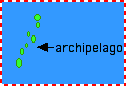 archipelago An archipelago is a group or chain of islands clustered together in a sea or ocean. |
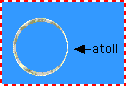 atoll An atoll is a ring (or partial ring) of coral that forms an island in an ocean or sea. The coral sits atop a submerged volcanic cone. |
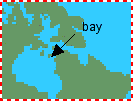 bay A bay is a body of water that is partly enclosed by land (and is usually smaller than a gulf). |
 butte A butte is a flat-topped rock or hill formation with steep sides. |
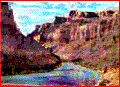 canyon A canyon is a deep valley with very steep sides - often carved from the Earth by a river. |
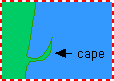 cape A cape is a pointed piece of land that sticks out into a sea, ocean, lake, or river. |
 cave A cave is a large hole in the ground or in the side of a hill or mountain. |
cay A cay is a low-lying sandy island formed atop a reef. |
channel A channel is a body of water that connects two larger bodies of water (like the English Channel). A channel is also a part of a river or harbor that is deep enough to let ships sail through. |
cliff A cliff is a steep face of rock and soil. |
col A mountain pass. |
continent The land mass on Earth is divided into continents. The seven current continents are Africa, Antarctica, Asia, Australia, Europe, North America, and South America. |
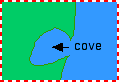 cove A cove is small, horseshoe-shaped body of water along the coast; the water is surrounded by land formed of soft rock. |
delta A delta is a low, watery land formed at the mouth of a river. It is formed from the silt, sand and small rocks that flow downstream in the river and are deposited in the delta. A delta is often (but not always) shaped like a triangle (hence its name, delta, a Greek letter that is shaped like a triangle). |
 desert A desert is a very dry area. |
dune A dune is a hill or a ridge made of sand. Dunes are shaped by the wind, and change all the time. |
 equator The equator is an imaginary circle around the earth, halfway between the north and south poles. |
 estuary An estuary is where a river meets the sea or ocean. |
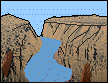 fjord A fjord is a long, narrow sea inlet that is bordered by steep cliffs. |
geomorphology Geomorphology is the scientific field that investigates how landforms are formed on the Earth (and other planets). |
 geyser A geyser is a natural hot spring that occasionally sprays water and steam above the ground. |
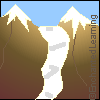 glacier A glacier is a long-lasting, slowly-moving river of ice on land. |
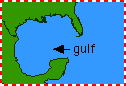 gulf A gulf is a part of the ocean (or sea) that is partly surrounded by land (it is usually larger than a bay). |
 hill A hill is a raised area or mound of land. |
 island An island is a piece of land that is surrounded by water. |
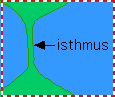 isthmus An isthmus is a narrow strip of land connecting two larger landmasses. An isthmus has water on two sides. |
key A key is a low-lying island (especially in the Caribbean Sea), usually formed by a reef. |
lagoon A lagoon is a shallow body of water that is located alongside a coast. |
 lake A lake is a large body of water surrounded by land on all sides. Really huge lakes are often called seas. |
 latitude Latitude is the angular distance north or south from the equator to a particular location. The equator has a latitude of zero degrees. The North Pole has a latitude of 90 degrees North; the South Pole has a latitude of 90 degrees South. |
 longitude Longitude is the angular distance east or west from the north-south line that passes through Greenwich, England, to a particular location. Greenwich, England has a longitude of zero degrees. The farther east or west of Greenwich you are, the greater your longitude. Midway Islands (in the Pacific Ocean) have a longitude of 180 degrees (they are on the opposite side of the globe from Greenwich). |
marsh A marsh is a type of freshwater, brackish water or saltwater wetland that is found along rivers, pond, lakes and coasts. Marsh plants grow up out of the water. |
mesa A mesa is a land formation with a flat area on top and steep walls - usually occurring in dry areas. |
 mountain A mountain is a very tall high, natural place on Earth - higher than a hill. The tallest mountain on Earth is Mt. Everest. |
 ocean An ocean is a large body of salt water that surrounds a continent. Oceans cover more the two-thirds of the Earth's surface |
 peninsula A peninsula is a body of land that is surrounded by water on three sides. |
plain Plains are flat lands that have only small changes in elevation. |
plateau A plateau is a large, flat area of land that is higher than the surrounding land. |
pond A pond is a small body of water surrounded by land. A pond is smaller than a lake. |
prairie A prairie is a wide, relatively flat area of land that has grasses and only a few trees. |
 river A river is a large, flowing body of water that usually empties into a sea or ocean. |
sea A sea is a large body of salty water that is often connected to an ocean. A sea may be partly or completely surrounded by land. |
sound A sound is a wide inlet of the sea or ocean that is parallel to the coastline; it often separates a coastline from a nearby island. |
source A source is the beginning of a river. |
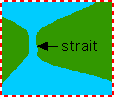 strait A strait is a narrow body of water that connects two larger bodies of water. |
surface runoff Surface runoff is water flow on the land that occurs when the soil is saturated with water and the excess water (from precipitation or snowmelt) runs over the surface. |
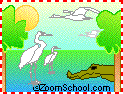 swamp A swamp is a type of freshwater wetland that has spongy, muddly land and a lot of water. Many trees and shrubs grow in swamps. |
tributary A tributary is a stream or river that flows into a larger river. |
 tundra A tundra is a cold, treeless area; it is the coldest biome. |
 valley A valley is a low place between mountains. |
 volcano A volcano is a mountainous vent in the Earth's crust. When a volcano erupts, it spews out lava, ashes, and hot gases from deep inside the Earth. |
 waterfall When a river falls off steeply, there is a waterfall. |
wetland A wetland is an area of land that is often wet; the soil in wetlands are often low in oxygen. Wetland plants are adapted to life in wet soil. There are many types of wetlands, including: swamp, slough, fen, bog, marsh, moor, muskeg, peatland, bottomland, delmarva, mire, wet meadow, riparian, etc. |