Advertisement.

EnchantedLearning.com is a user-supported site.
As a bonus, site members have access to a banner-ad-free version of the site, with print-friendly pages.
Click here to learn more.

Join Enchanted Learning
Site subscriptions last 12 months.
Click here for more information on site membership.
$20.00/year or other amount
(directly by Credit Card)
$20.00/year or other amount
(via PayPal)
$20.00/year or other amount
(for sending a check by mail)
$20.00/year or other amount
(for subscribing by school purchase order)
As a thank-you bonus, site members have access to a banner-ad-free version of the site, with print-friendly pages.
(Already a member? Click here.)

ZoomDinosaurs.com
Dinosaur and Paleontology Dictionary
A B C D E F G H I J K L M N O P Q R S T U V W X Y Z

Click on an underlined word for more information on that subject.
If the dinosaur or paleontology term you are looking for is not in the dictionary, please e-mail us.

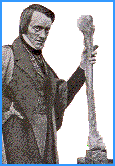
Sir Richard Owen

Sir Richard Owen (1804-1892) was a pioneering British comparative anatomist who coined the term dinosauria (from the Greek "deinos" meaning fearfully great, and "sauros" meaning lizard), recognizing them as a suborder of large, extinct reptiles.

He had noticed that a group of fossils (which included remains of Megalosaurus, Iguanodon, and Hylaeosaurus) had certain characteristics in common, including: Owen proposed this new name in an article published in the "Proceedings of the British Association for the Advancement of Science" in 1842. In that article, Owen wrote, "The combination of such characters, some, as it were, from groups now distinct from each other, and all manifested by creatures far surpassing in size the largest of existing reptiles, will, it is presumed, be deemed sufficient ground for establishing a distinct tribe or suborder of Saurian Reptiles, for which I would propose the name of Dinosauria." (from Owen's "Report on British Fossil Reptiles." Part II. Report of the British Association for the Advancement of Science, Plymouth, England, 1842).

Owen presented dinosaurs as a separate taxonomic group in order to bolster his arguments against the newly proposed theory of evolution (although Darwin's "Origin of the Species" wasn't published until 1859, the basic ideas of evolution were known, but its mechanisms, including natural selection, were not). Ironically, his work actually helped support the evolutionists arguments.

Owen named and described the following dinosaurs: Anthodon (1876), Bothriospondylus (1875), Cardiodon (1841), Cetiosaurus (1841 - but Owen incorrectly thought that it was a kind of crocodile and not a dinosaur), Chondrosteosaurus (1876), Cimoliornis (1846), Cladeidon (1841), Coloborhynchus (1874), Dacentrurus (1875), Dinodocus (1884), Echinodon (1861), Massospondylus (1854), Nuthetes (1854), Polacanthus (1867), and Scelidosaurus (1859).

Owen also named Hyracotherium (Eohippus) in 1841; it is the earliest-known horse.


Enchanted Learning®
Over 20,000 Web Pages.
Sample Pages for Prospective Subscribers

Overview of Site
What's New
Enchanted Learning Home
Monthly Activity Calendar
Books to Print
Site Index

K-3
Crafts
K-3 Themes
Little Explorers
Picture dictionary
PreK/K Activities
Rebus Rhymes
Stories
Writing
Cloze Activities
Essay Topics
Newspaper
Writing Activities
Parts of Speech

Fiction
The Test of Time
Biology
Animal Printouts
Biology Label Printouts
Biomes
Birds
Butterflies
Dinosaurs
Food Chain
Human Anatomy
Mammals
Plants
Rainforests
Sharks
Whales
Physical Sciences
Astronomy
The Earth
Geology
Hurricane
Landforms
Oceans
Tsunami
Volcano
Languages
Dutch
French
German
Italian
Japanese (Romaji)
Portuguese
Spanish
Swedish
Geography/History
Explorers
Flags
Geography
Inventors
US History

Other Topics
Art and Artists
Calendars
Crafts
Graphic Organizers
Label Me! Printouts
Math
Music

Click to read our Privacy Policy

E-mail


Enchanted Learning Search

First search engine with spelling correction and pictures!
Search EnchantedLearning.com for all the words:
Enter one or more words, or a short phrase.
You can use an asterisk * as a wild-card.


Advertisement.


Advertisement.


Copyright ©1998-2008 EnchantedLearning.com ------ How to cite a web page