



Apatosaurus/Brontosaurus
The “Deceptive Lizard” / A Harmless Giant
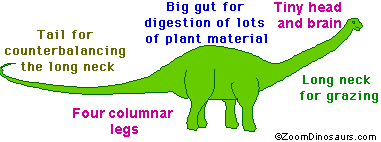
- Plant eater
- Small head with spatulate or pencil-shaped teeth
- Walked on four legs
- Among the largest land animals!
Anatomy
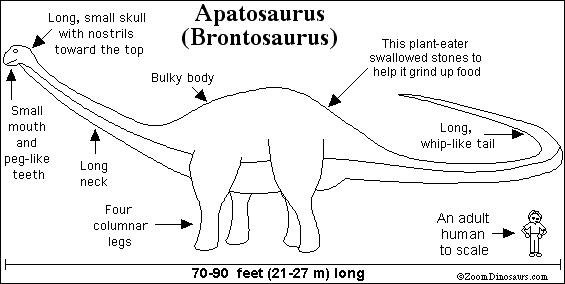
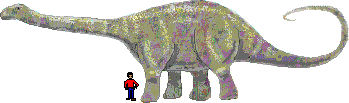 Apatosaurus/Brontosaurus was one of the largest land animals that ever existed. The dinosaur Brontosaurus is now called Apatosaurus. This enormous plant-eater measured about 70-90 feet (21-27 m) long and about 15 feet (4.6 m) tall at the hips. It weighed roughly 33-38 tons (30-35 tonnes). Its head was less than 2 feet long; it had a long skull and a very tiny brain. This plant-eater had a long neck (with 15 vertebrae), a long whip-like tail (about 50 ft = 15 m long), a hollow backbone, peg-like teeth in the front of the jaws, and four massive, column-like legs. Its hind legs were larger than the front legs. Fossilized Apatosaurus footprints (called trackways) have been found (in Colorado, USA) that were about a yard wide.
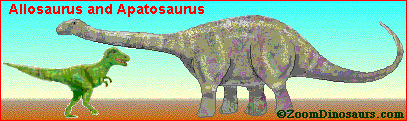 Apatosaurus could have held its head at most 17 feet (5.4 m) off the ground (Parrish and Stevens,1999). Allosaurus, which was the biggest meat-eater at that time in North America, was only 15 feet (4.6 m) tall. This afforded Apatosaurus protection from predators, since carnivores like Allosaurus couldn’t attack its head or neck, and probably had more sense than to attack its gigantic, clawed feet or whip-like tail.
Strangely, Apatosaurus’ nostrils were located on the top of its head. No one is sure what purpose this served. It used to be thought that this was a snorkel-like device for a water-dwelling animal, but this theory has been repudiated. Since Apatosaurus fossils have been found far from any water-dwelling fossils, it is now believed that Apatosaurus spent most of its time on land, far from large bodies of water or swamps.
Why was Apatosaurus’ neck so long?
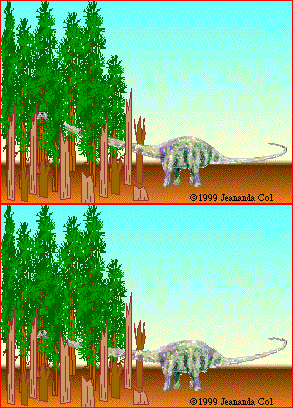 Apatosaurus held its neck more-or-less horizontally (parallel to the ground). The long neck may have been used to “mow” wide swaths of vegetation or to poke over or into stands of trees to get foliage that was otherwise unavailable to the huge, lumbering varieties of sauropods who could not venture into forests because of their size. Alternatively, the long neck may have enabled this sauropod to eat soft pteridophytes (horsetails, club mosses, and ferns). These soft-leaved plants live in wet areas, where sauropods couldn’t venture, but perhaps the sauropod could stand on firm ground and browse in wetlands.
Behavior & life span
Although many sauropods may have traveled in herds, bonebeds of Apatosaurus fossils have not been found. Apatosaurus may have been a solitary animal.
Sauropods’ life spans may have been on the order of 100 years.
Eggs
Apatosaurus, like other sauropods, hatched from enormous eggs up to a 1 foot (30 cm) wide. Sauropod eggs have been found in a linear pattern and not in nests; presumably the eggs were laid as the animal was walking. It is thought that sauropods did not take care of their eggs .
Diet
- GASTROLITHS
 (pronounced GAS-troh-liths) Gastroliths are stones that some animals swallow and use to help grind up tough plant matter in their digestive system. Gastroliths are also called gizzard rocks. Apatosaurus swallowed stones to use as gastroliths.
 This huge, extremely heavy reptile was an herbivore (it ate only plants, like conifers, other tree leaves and ferns). It must have eaten a tremendous amount of plant material each day to sustain itself. Apatosaurus must have spent almost all of its time grazing. It had blunt pencil-like teeth, arrayed like a garden rake; these were useful for stripping and gathering foliage. According to paleontologist Robert Bakker, Apatosaurus may have had thick, moose-like lips that would help in gathering plant material.
Apatosaurus swallowed leaves and other vegetation whole, without chewing them, and had gastroliths (stomach stones) in its stomach to help digest this tough plant material.
Apatosaurs’ main food was probably conifers, which were the dominant plant when the large sauropods lived. Secondary food sources may have included gingkos, seed ferns, cycads, bennettitaleans, ferns, club mosses, and horsetails.
Neck mobility
A recent study by paleontologist J. Michael Parrish (published in Science, April 30, 1999) seems to indicate that Apatosaurus and Diplodocus had very limited neck mobility. Parrish (from Northern Illinois University) used computer models of fossils to test how far these enormous animals could move. Muscle attachments were based on bird and crocodile models.
Parrish said that that even though these sauropods had necks that were 40+ feet (12.5 m) long, these plant-eaters could not lift their heads more than about 9 to 12 feet (3-4 to m). They must have held their heads straight out or downwards most of the time, and not up. They could swing the head and neck very freely sideways to browse for vegetation. Parrish said, “The maximum amount they were able to raise their heads was just a little bit above the height of their back. If you raise the neck any higher, the vertebrae run into each other and the back locks up.” This would limit the grazing of the treetops leaves (like conifers and gingkos).
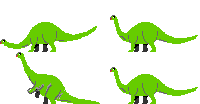 Parrish said, “It was a surprising result, We didn’t think there would be any problem with them raising their heads, but it turns out there is a real, physical limit.” Parrish continued, “I don’t think our study answers whether they could rise up on their hind legs, but if they did there would be a blood pressure problem. I don’t think they would use that as a predominant way of feeding, as some people have suggested.”
 If this computer modelling study proves correct, then many things can be surmised about Apatosaurus. For example, Apatosaurus could not live in a forest environment, or its head would be constantly hitting trees and it moved left and right, browsing vegetation. Since grasses hadn’t evolved yet, they may have eaten a lot of relatively nutritious, low-lying plants, like ferns, horsetails, and algae.
Movement
Apatosaurus moved very slowly on four legs (as determined from fossilized tracks and its leg length and estimated mass). Paleontologists theorize that Apatosaurus may have used its tail as a third leg in order to graze very tall vegetation.
Blood pressure problems
Apatosaurus and some of the other large sauropods (the huge long-necked plant-eaters) needed to have large, powerful hearts and very high blood pressure in order to pump blood up the long neck to the head and brain. The heads (and brains) of Apatosaurus was held high (many meters) above its heart. This presents a problem in blood-flow engineering. In order to pump enough oxygenated blood to the head to operate Apatosaurus’ brain (even its tiny sauropod brain) would require a large, powerful heart, tremendously high blood pressure, and wide, muscular blood vessels with many valves (to prevent the back-flow of blood). Apatosaurus’ blood pressure was probably over 400 mm Mercury, three or four times as high as ours.
Intelligence
It used to be thought that the sauropods (like Brachiosaurus and Apatosaurus) and Stegosaurus had a second brain. Paleontologists now think that what they thought was a second brain was just an enlargement in the spinal cord in the hip area. This enlargement was larger than the animal’s tiny brain.
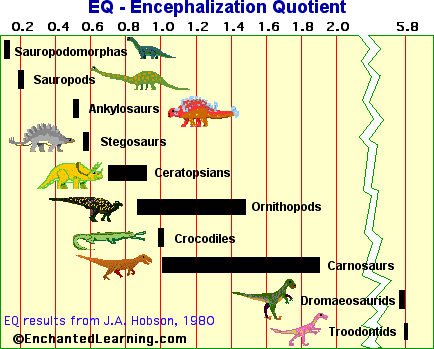
Apatosaurus was a sauropod, whose intelligence (as measured by its relative brain to body weight, or EQ) was the among the lowest of the dinosaurs.
When Apatosaurus lived
Apatosaurus lived during the late Jurassic Period, about 157-146 million years ago. There was a minor mass extinction toward the end of the Jurassic period. During this extinction, most of the stegosaurid and enormous sauropod dinosaurs died out, as did many genera of ammonoids, marine reptiles, and bivalves. No one knows what caused this extinction.
Among Apatosaurus’ contemporaries in North America during the late Jurassic Period were many fellow sauropods, including Diplodocus, Camarasaurus, Brachiosaurus, Ultrasauros, Supersaurus, Seismosaurus and Barosaurus. Theropods from that time and place included Allosaurus, Ceratosaurus, Marshosaurus, Stokesosaurus, and Coelurus. Ornithischian contemporaries included Camptosaurus, Dryosaurus, and Stegosaurus.
Apatosaurus and Brontosaurus
The American paleontologist Othniel C. Marsh described and named Apatosaurus in 1877. A few years later, in 1879, he described and named another dinosaur fossil, Brontosaurus (which means “thunder lizard”). It turned out that the two dinosaurs were actually two species of the same genus. The earlier scientific name, Apatosaurus, was retained, and the name Brontosaurus was no longer used.
Some people call Apatosaurus “Long-neck.”
Fossils and the name
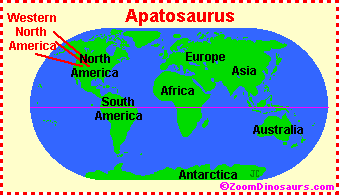 Many fossils of Apatosaurus have been found in Colorado, Oklahoma, Utah, and Wyoming, in the USA. An Apatosaurus vertebrae was found with Allosaurus tooth marks etched into it, evidence of an ancient Allosaurus attack.
Apatosaurus was named in 1877 by US paleontologist Othniel C. Marsh. It was called Apatosaurus, which means “deceptive lizard,” because its fossils were so similar to those of other sauropods.The first relatively complete Apatosaurus fossil was found by Earl Douglass in the Morrison Formation (then called the Carnegie quarry) in Colorado, USA.
Skull Problems and Scientific Bullying: The original Brontosaurus fossil, found in 1879, lacked a skull (as many fossils do). Othniel Marsh added a skull found miles away (this skull did not belong to the Brontosaurus, but to a Camarasaurus). In 1900, Henry Osborn assembled another skull-less Brontosaurus at the American Museum of Natural History in New York City, adding a cast of Marsh’s skull. In 1915, Earl Douglass of the Carnegie Museum found a Brontosaurus fossil that included the skull, but because of Osborn’s influence, the Carnegie displayed the fossil skull-less. When Douglas died in 1932, the incorrect skull was put on display! It wasn’t until 1975 that the proper skull was mounted on Brontosaurus/Apatosaurus fossils in museums. The paleontologist Jack McIntosh identified the correct skull for Apatosaurus and has done much to popularize the use of the name Apatosaurus.
The following species of Apatosaurus have been found:
- Apatosaurus ajax - found in Colorado
- A. excelsus - found in Oklahoma, Utah, and Wyoming
- A. louisae - found in Colorado
- A. yahnahpin - found in Wyoming
Apatosaurus Activities
- Find It! - A print-out for 2nd Graders. Skills: reading, writing, research, and comprehension.
- An Apatosaurus information page to print and color!
- Print out a K-3 level Apatosaurus info page to color!
- A first-grade level Apatosaurus subtraction activity print-out.
- An Apatosaurus word hunt activity - For second and third graders.
- A quiz about Apatosaurus - Unscramble the answers and see how much you know this long-necked dinosaur! For grades 2-3.
- Apatosaurus Q and A
- Apatosaurus Fact Sheet and a printable version
Classification
Apatosaurus (which used to be known as Brontosaurus) belonged to the:
- Kingdom Animalia (animals)
- Phylum Chordata (having a hollow nerve chord ending in a brain)
- Class Archosauria (diapsids with socket-set teeth, etc.)
- Order Saurischia - lizard-hipped dinosaurs, the ancestors of birds
- Sauropodomorph - long-necked, long-tailed plant-eaters who walked on four legs
- Suborder Sauropoda (sauropods) - very large herbivores
- Neosauropoda - advanced sauropods
- Family Diplodocidae - whip-tailed, peg-toothed sauropods with high spines on the vertebrae. These included Amargasaurus, Diplodocus, Barosaurus, Seismosaurus, Supersaurus, and others
- Genus Apatosaurus
- Species A. Ajax (the type species). Other species of Apatosaurus include A. excelsus, A. louisae, and perhaps A. montanus.
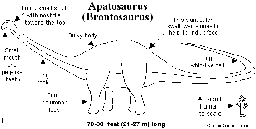
Apatosaurus Printout. Apatosaurus was a large, plant-eating dinosaur with a long neck and a whip-like tail. It was a sauropod that lived during the Jurassic period, about 157-146 million years ago.
Apatosaurus to color. Make a stuffed Apatosaurus from paper. Dinosaurs in the Classroom has K-12 curriculum ideas and class projects.

Apatosaurus/Brontosaurus was a huge, long-necked, plant-eating dinosaur that lived during the Jurassic period. It was one of the largest land animals that ever lived.

Learn about Apatosaurus (formerly Brontosaurus), a huge, long-necked, plant-eating dinosaur that lived during the Jurassic period.
Other Dinosaur Info Sheets
Just click on an animal’s name to go to that information sheet. If the dinosaur you’re interested in isn’t here, check the Dinosaur Dictionary or the list of Dinosaur Genera.
How to write a great dinosaur report.
Names with an asterisk (*) were not dinosaurs.