



Basic Info
| Name | Allosaurus |
|---|---|
| Meaning | Different lizard |
| Named by | O. Marsh, 1883 |
| Length | 38 ft (12 m) |
| Diet | Meat |
| Walk | Bipedal |
| Time | Late Jurassic, 154-144 mya |
| Location | W. North America, Australia |
| Classification | Theropod |
Allosaurus was a large, meat-eating dinosaur . It was the biggest meat-eater in North America during the late Jurassic period.
Anatomy
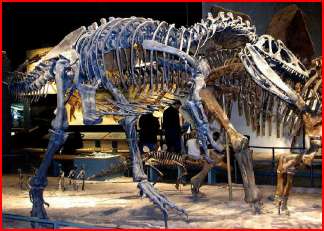
Photo courtesy of Jim Puckett, using an Olympus 3040 digital camera - taken in the Dinosaur Hall of “Prehistoric Journey” at the Denver Museum of Nature and Science
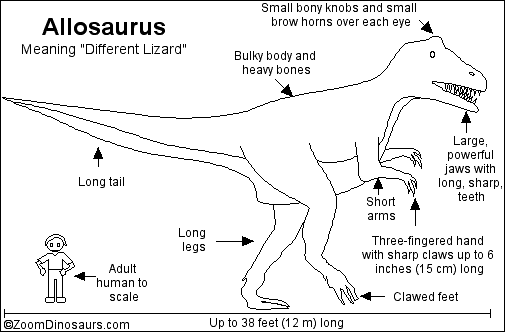
Allosaurus was a powerful predator that walked on two powerful legs, had a strong, S-shaped neck, and had vertebrae that were different from those of other dinosaurs (hence its name, the “different lizard”). It had a massive tail, a bulky body, and heavy bones. Its arms were short and had three-fingered hands with sharp claws that were up to 6 inches (15 cm) long.
Allosaurus was up to 38 feet long (12 m) and 16.5 feet tall (5 m). It weighed about 1400 kg. It had a 3 feet long (90 cm) skull with two short brow-horns and bony knobs and ridges above its eyes and on the top of the head. It had large, powerful jaws with long, sharp, serrated teeth 2 to 4 inches (5 to 10 cm) long.
Gastralia (hanging belly ribs) are thin, fragile ribs that helped support and protect the internal organs (like the lungs) in the middle area of the body. These ribs were not attached to the backbone; they were attached to the skin in the belly area.
The different species of Allosaurus varied in weight. Allosaurus fragilis, A. atrox, and A. ferox weighed about 1.1 to 1.9 tons (1 tonne to 1.7 tonnes); A. amplexus was much heavier and weighed about 2.7 to 5.5 tons (3 tonnes to 5 tonnes).
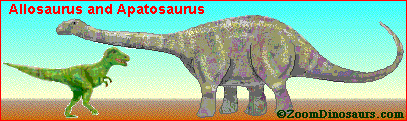
An Apatosaurus vertebra was found with Allosaurus tooth marks etched into it, evidence of an ancient Allosaurus attack.
Diet and teeth
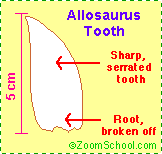
 Allosaurus was a huge carnivore, a meat eater equipped with sharp, pointed teeth in large, powerful jaws - it was the biggest meat-eater in its habitat. This theropod also had long, sharp clawed hands. Allosaurus probably ate large, plant-eating dinosaurs, like Stegosaurus.
Allosaurus was a large, fierce predator that could kill medium-sized sauropods (or sick or injured large sauropods like Apatosaurus) and many others of its contemporaries. An Apatosaurus (a large sauropod) vertebra was found with Allosaurus tooth marks on it. Allosaurus may also have been a scavenger.
Allosaurus may have faced competition from the meat-eating Ceratosaurus.
Behavior
Allosaurus may have hunted in groups. In groups, Allosaurus could ambush even the very large sauropods (like Diplodocus and Camarasaurus). It probably also preyed upon stegosaurs and iguanodonts. Allosaurus was the most abundant predator in late Jurassic North America.
Intelligence
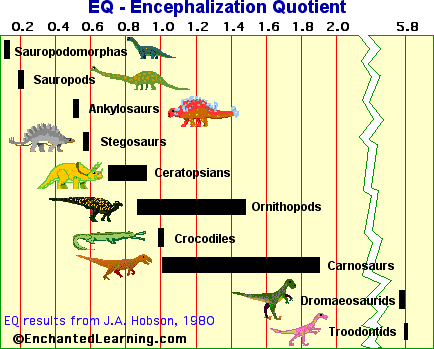
Allosaurus was a carnosaur, whose intelligence (as measured by its relative brain to body weight, or EQ) was high among the dinosaurs.
Locomotion
Allosaurus walked on two muscular legs. Allosaurus’ leg length was about 1.38 m; its stride length (distance between footprints) was about 2.72 m. Allosaurus’ femur (thigh bone) was about 30 inches (77 cm) long.
There has been some discussion on whether or not the massive, short-armed theropods (like T. rex, Giganotosaurus, Albertosaurus, and Allosaurus) could run very fast because if they fell, their short arms would not break their fall and they would be badly injured (James Farlow, 1995). This meant that these large theropods were slow, lumbering animals.
Dr. Bruce Rothschild, of the Arthritis Center of Northeast Ohio, has found evidence of 14 fractured ribs in an Allosaurus that reflect healed injuries that were probably received in falls. These were most likely bellyflops that happened while running (as reported in the April 16, 1998, New Scientist).
 An X-ray analysis of the Allosaurus fossil indicated that the Allosaurus ribs near the scapula (the shoulder bone) were cracked and had healed. The Allosaurus was capable of recovering after many severe forward tumbles that probably occurred while it was running. So the suggestion that perhaps the large short-armed theropods were not capable of running because they couldn’t recover after a fall apparently wasn’t so, at least for Allosaurus - this Allosaurus did recover many times after bad tumbles.
In 1995 James Farlow of Indiana’s Purdue University argued that a large T. rex could run no faster than 20 mph (32 kph), because if it did, a fall would probably be so severe as to kill it. T. rex weighed about 6 tons and was up to 20 feet (6 m) tall but Allosaurus was slightly smaller, about 3 tons and 16.5 feet (5 m) long. Farlow says that Rothschild’s analysis is consistent with his theory since Allosaurus was smaller and lighter than T. rex (its smaller mass would make the impact much less powerful so the animal may have been able to recover after a running fall).
When Allosaurus lived
Allosaurus was the biggest meat-eater during the late Jurassic period, about 154 to 144 million years ago.
Discovery and naming of fossils
 Allosaurus was named in 1877 by paleontologist Othniel C. Marsh. The first virtually complete Allosaurus skeleton was discovered by rancher M. P. Felch in 1883, in Colorado, USA.
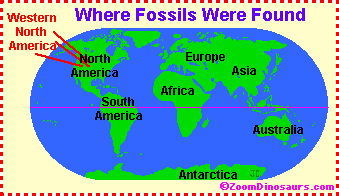
Over 60 Allosaurus fossils have been found, mostly in the Morrisson Formation in Colorado, USA, but also in other locations in western North America and one possible find in Australia. Allosaurus fossils may have also been found in Africa and Portugal, Europe.
Apatodon may in fact be Allosaurus.
Classification
Allosaurus belonged to the:
- Kingdom Animalia (animals)
- Phylum Chordata (having a hollow nerve chord ending in a brain)
- Class Archosauria (diapsids with socket-set teeth, etc.)
- Order Saurischia - lizard-hipped dinosaurs
- Suborder Theropoda - bipedal carnivores
- Tetanurae -advanced theropods
- Neotetanurae - late tetanurans
- Infraorder Carnosauria = Allosauria - large predators, many with head crests, including Carcharodontosaurus and Giganotosaurus
- Family Allosauridae (huge carnivores with bony head ridges that may have hunted in packs; they included Allosaurus, Saurophaganax, and Neovenator.
- Genus Allosaurus
- species A. fragilis (the type species; Marsh, 1877)
- species A. amplexus (Cope, 1878, originally called Epanterias)
- species A. atrox (Marsh, 1878, originally called Creosaurus)
- species A. ferox (Marsh, 1896)
Links and activities
Other Dinosaur Info Sheets
Just click on an animal’s name to go to that information sheet. If the dinosaur you’re interested in isn’t here, check the Dinosaur Dictionary or the list of Dinosaur Genera.
How to write a great dinosaur report.
Names with an asterisk (*) were not dinosaurs.