
|
 Table of Contents |
Enchanted Learning ALL ABOUT BUTTERFLIES! |
Butterfly Calendar |
| What is a Butterfly? | Life Cycle | Butterfly Anatomy | Information Sheets | Glossary | Printables and Activities |
| Butterfly Glossary |
| A | B | C | D | E | F | G | H | I | J | K | L | M | N | O | P | Q | R | S | T | U | V | W | X-Z |
 FACET A facet is one of the hexagonal units of the compound eye - the surface of a single ommatidium. |
FAMILY In classification, a family is a group of related or similar organisms. A family contains one or more genera (plural of genus). A group of similar families forms an order. |
FAT BODY A fat body stores the food energy of a butterfly or moth. |
 FILAMENTS Some caterpillars have filaments (also known as tentacles) on their bodies. These fleshy appendages provide sensory information for the caterpillar. They are often mistaken for antennae. Monarch caterpillars have two pairs of filaments. |
 FOLIAGE Foliage is the leaves of plants. Caterpillars eat foliage. |
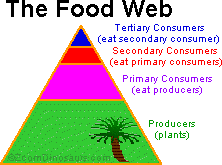 FOOD CHAIN A food chain is is the sequence of who eats whom in a biological community (an ecosystem) to obtain nutrition. A food web is all of the interactions between predators and prey in which plants and animals obtain food in an ecoystem. The chain starts with plants or other autotrophs (organisms that make their own food from light and/or chemical energy) that are eaten by herbivores (plant-eaters). The herbivores are eaten by carnivores (meat-eaters). These are eaten by other carnivores. When any organism dies, it is eaten by tiny microbes (detrivores) and the exchange of energy continues. |
 FOREST Forests are dense concentrations of trees over a large area of land. |
FOREST FLOOR The forest floor is the lowest layer of a rainforest, extending from the ground to about 3 feet (1 m) high. This layer is teeming with animal life, especially insects. The largest animals in the rainforest generally live here. |
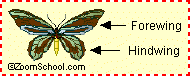 FOREWINGS Forewings are the two upper wings of flying insects, like butterflies and moths. |
 FOSSIL Fossils are mineralized impressions or casts of ancient animals and plants. Fossils have been found on every continent on Earth. Butterfly fossils are rare. The earliest butterfly fossils are from the early Cretaceous period, about 130 million years ago. |
FRASS Frass is caterpillar waste, which is pellet-like. Caterpillars produce a lot of frass. |
FRENULUM A frenulum is a small spine-like lobe that projects from a moth's hindwing. This structure helps hold the hindwings and the forewings together while the moth is flying. |
FRITILLARY Fritillaries are a type of brush-footed butterflies. The front two legs of the adult are greatly reduced in size (and are covered with hair), making it appear as though these butterflies have only four legs. The caterpillars of many fritillaries are nocturnal 9most active at night) and eat on violet leaves. The pupa hangs in a head-down position. Classification: Family Nymphalidae (brush-footed butterflies), Subfamily Heliconiinae (Heliconians and Fritillaries), many genera (including Speyeria, Boloria, and Euptoieta) and speciess. |
|
Butterfly Glossary |
|
|||||
| A | B | C | D | E | F | G | H | I | J | K | L | M | N | O | P | Q | R | S | T | U | V | W | X-Z |
Enchanted Learning®
Over 35,000 Web Pages
Sample Pages for Prospective Subscribers, or click below
|
Overview of Site What's New Enchanted Learning Home Monthly Activity Calendar Books to Print Site Index K-3 Crafts K-3 Themes Little Explorers Picture dictionary PreK/K Activities Rebus Rhymes Stories Writing Cloze Activities Essay Topics Newspaper Writing Activities Parts of Speech Fiction The Test of Time
|
Biology Animal Printouts Biology Label Printouts Biomes Birds Butterflies Dinosaurs Food Chain Human Anatomy Mammals Plants Rainforests Sharks Whales Physical Sciences: K-12 Astronomy The Earth Geology Hurricanes Landforms Oceans Tsunami Volcano |
Languages Dutch French German Italian Japanese (Romaji) Portuguese Spanish Swedish Geography/History Explorers Flags Geography Inventors US History Other Topics Art and Artists Calendars College Finder Crafts Graphic Organizers Label Me! Printouts Math Music Word Wheels |
Click to read our Privacy Policy
| Search the Enchanted Learning website for: |