



 |


|


|


|


|

|


|


|


|
|
|
|
|
|
|
|
|
|
|
|
|
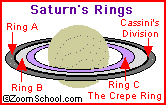 Saturn’s beautiful rings are only visible from Earth using a telescope. They were first observed by Galileo in 1610 (using his 20-power telescope).
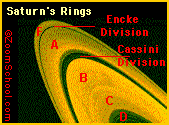 The rings are divided into 8 major ring divisions. There are two main sections (called rings A and B) plus the smaller ring (Ring C or the Crepe ring), D and F rings; the larger gap in the rings is called the Cassini division; the smaller one is the Encke division. Starting closest to Saturn, the rings and divisions are: D, C, B, The Cassini Division, A, the Encke division, and F (subdivided into G and E, and a ring with visible clumps of matter, called knots). A huge, distant eighth ring tilted 27 degrees from the planet’s main ring plane was discovered in 2009.
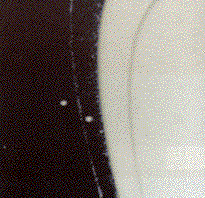
Saturn’s moon Prometheus and Pandora,
shepherding Saturn’s narrow, outer F Ring.
The rings show intricate structure; some of this structure is from the gravitational effect of shepherding moons, but much about these rings is unknown.
Saturn’s bright rings are made of ice chunks and rocks that range in size from the size of a fingernail to the size of a car. Although the rings are very extremely wide (almost 185,000 miles = 300,000 km in diameter), they are very thin (about 0.6 miles = 1 km thick).
| Ring/Gap | Start radius (km) from the center of Saturn | End radius (km) | Width (km) |
|---|---|---|---|
| D | 67,000 km | 74,500 km | 7,500 km |
| C | 74,500 km | 92,000 km | 17,500 km |
| Maxwell Gap | 87,500 km | 87,770 km | 270 km |
| B | 92,000 km | 117,500 km | 25,500 km |
| Cassini Division | 117,500 km | 122,200 km | 4,700 km |
| A | 122,200 | 136,800 | 14,600 |
| Encke Gap | 133,570 km | 133,895 | . |
| Keeler Gap | 136,530 | 136,565 | 35 |
| F | 140,210 | 140,240-140,710 | 30-500 km |
| G | 165,800 | 173,800 | 8,000 |
| E | 180,000 | 480,000 | 300,000 |
| ? | 5.95 million | 17.85 million | 11.9 million |