



 |


|


|


|


|
|


|


|


|
|
|
|
|
|
|
|
|
|
|
|
|
Introduction
 Jupiter has faint, dark, narrow rings composed of tiny rock fragments and dust. They do not contain ice, like Saturn’s rings. Jupiter’s rings are continuously losing material and being resupplied with new dust from micrometeors hitting Jupiter’s four inner moons (Metis, Adrastea, Amalthea, and Thebe).
Discovery
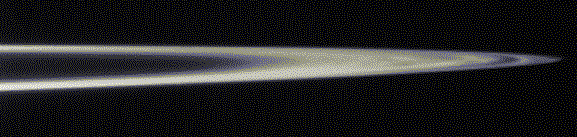
This photo of Jupiter’s ring was taken by NASA’s Galileo spacecraft in 1996.
Jupiter’s rings were discovered by NASA’s Voyager 1 in 1980. The rings were investigated further when Voyager 2 flew by Jupiter.
Albedo
The rings have an albedo of 0.05; they do not reflect very much of the sunlight that they receive.
Three Sections
Jupiter’s ring is in three sections: the Main ring, a Halo that orbits closer to Jupiter, and a very wide Gossamer ring that extends far from Jupiter.
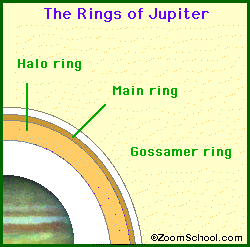
- The Halo ring is a faint, wide ring that has the shape of a doughnut. It is about 22,800 wide and is about 20,000 km thick. This ring starts at 100,000 km from the center of Jupiter; the outer edge of the Halo merges into the Main ring.
- The Main ring is 6,400 km wide an less than 30 km thick. This very thin ring has a mass of about 10 13 kg. The ring is about 7,000 km wide; it starts at 122,800 km from the center of Jupiter and has an abrupt outer edge 129,130 km from the center of Jupiter. Two small moons, Adrastea and Metis, orbit within the Main ring; they may be the source of the dust in this ring.
- The Gossamer ring is a very faint and very wide ring. It consists of two rings, one embedded within the other. It is composed of very tiny particles, the microscopic debris from the moons, Amalthea and Thebe. The Gossamer ring starts at 129,000 km from the center of Jupiter and extends beyond the orbit of the moon Amalthea.