
|
| Table of Contents | Enchanted Learning All About Astronomy |
Site Index |
| Our Solar System | Stars | Glossary | Printables, Worksheets, and Activities | ||||||
| The Sun | The Planets | The Moon | Asteroids | Kuiper Belt | Comets | Meteors | Astronomers | ||
| The Moon |
| General Description |
Inside the Moon | Craters | Phases of the Moon | Why Do We See Only One Side of the Moon? | Tides | Activities, Web Links |
| Map | Lunar Eclipses |
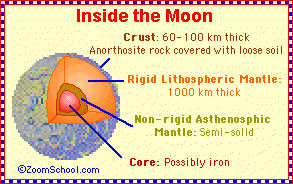 The interior of the moon is layered into a hard, outer crust, a rigid outer mantle, a semi-rigid inner mantle, and a core. The interior of the moon is cooler than the interior of the Earth. Since the moon is so small (and so its surface area to volume ratio is large compared to that of the Earth), it loses its heat quickly into space. Since the Earth and the moon formed, the moon has cooled down much more than the Earth.
Crust: The moon's surface is dry, dusty and rocky. The rocky crust is about 37 miles (60 km) thick on the side of the moon that faces Earth and about 62 miles (100 km) thick on the opposite side of the Moon. Radioactive dating of moon rocks from NASA's Apollo mission dates the formation of the moon from about 4.3 billion years ago (about 60 million years after the formation of the Earth). Moon rocks that have been analyzed by NASA are similar to Earth rocks, but are richer in the elements aluminum and titanium. When the minerals Armalcolite (named for the three astronauts on NASA's Apollo 11: Neil A. ARMstrong, Buzz ALdrin, and Michael COLlins), Tranquillityite, and Pyroxferroite were found on the moon, they were not known on the Earth. At least some of these minerals have since been found on the Earth.
Rigid lithospheric mantle: This rocky layer is not hot enough to flow. This hard shell is about 620 miles (1,000 km) thick.
Non-rigid mantle: Only the deepest parts of this asthenospheric layer (rock which is less rigid than in a lithosphere but rigid enough to transmit seismic waves) are hot enough to flow.
Core: The non-fluid core may be composed of iron-rich rock. The core contains only about 2-4 percent of the Moon's total mass; this core is probably about 225 miles (360 km) in diameter).
This small, non-fluid core does not create much of a magnetic field; the moon's magnetic field is about one ten-millionth of the Earth's magnetic field. A compass wouldn't work on the moon, but since the sky is always dark (because there is no atmosphere), you could navigate by looking at the stars.
Enchanted Learning®
Over 35,000 Web Pages
Sample Pages for Prospective Subscribers, or click below
|
Overview of Site What's New Enchanted Learning Home Monthly Activity Calendar Books to Print Site Index K-3 Crafts K-3 Themes Little Explorers Picture dictionary PreK/K Activities Rebus Rhymes Stories Writing Cloze Activities Essay Topics Newspaper Writing Activities Parts of Speech Fiction The Test of Time
|
Biology Animal Printouts Biology Label Printouts Biomes Birds Butterflies Dinosaurs Food Chain Human Anatomy Mammals Plants Rainforests Sharks Whales Physical Sciences: K-12 Astronomy The Earth Geology Hurricanes Landforms Oceans Tsunami Volcano |
Languages Dutch French German Italian Japanese (Romaji) Portuguese Spanish Swedish Geography/History Explorers Flags Geography Inventors US History Other Topics Art and Artists Calendars College Finder Crafts Graphic Organizers Label Me! Printouts Math Music Word Wheels |
Click to read our Privacy Policy
| Search the Enchanted Learning website for: |