
| Join Enchanted Learning Site subscriptions last 12 months. Click here for more information on site membership. |
|||
| As a thank-you bonus, site members have access to a banner-ad-free version of the site, with print-friendly pages. | |||
| More Cloze Activities | Cloze Activity Fill in the blanks below. |
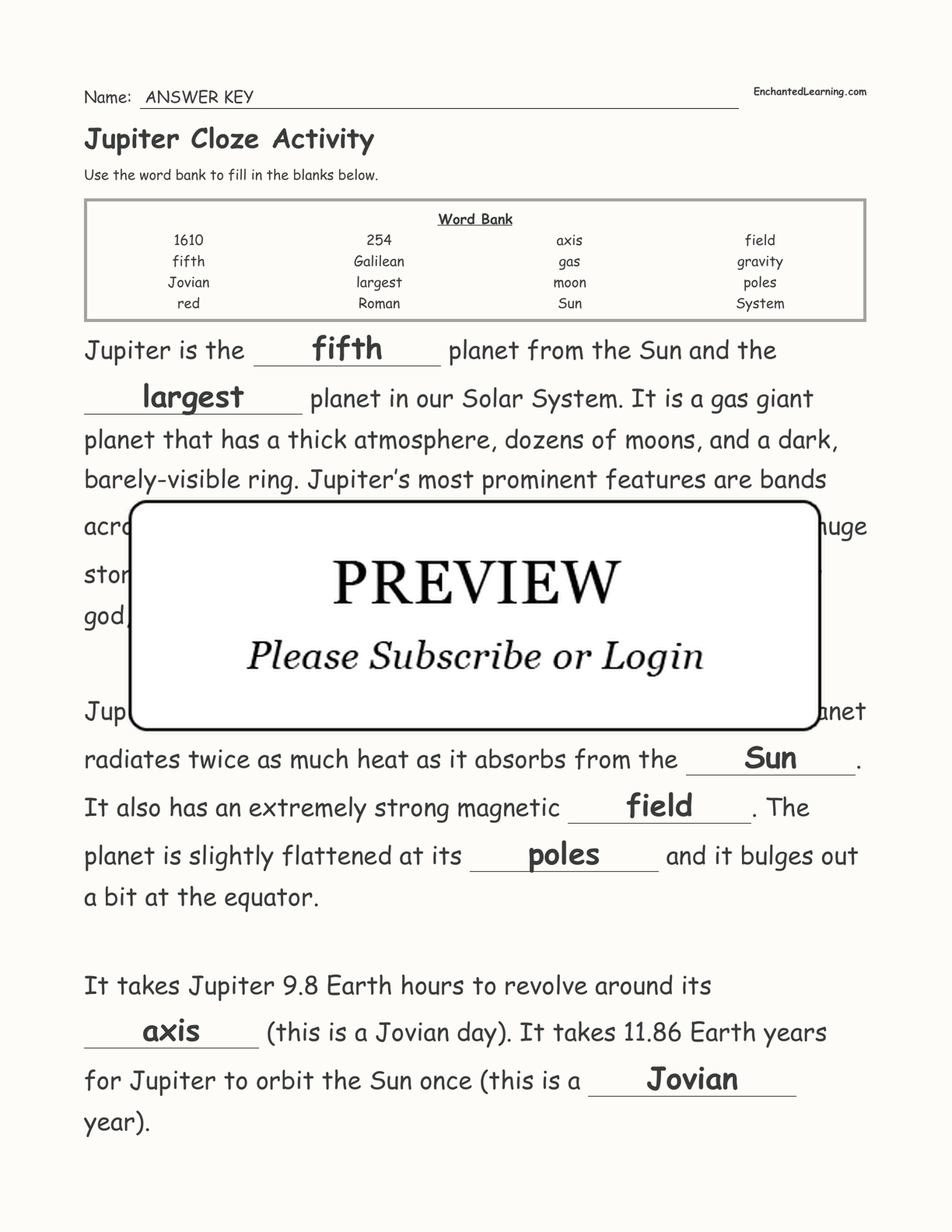
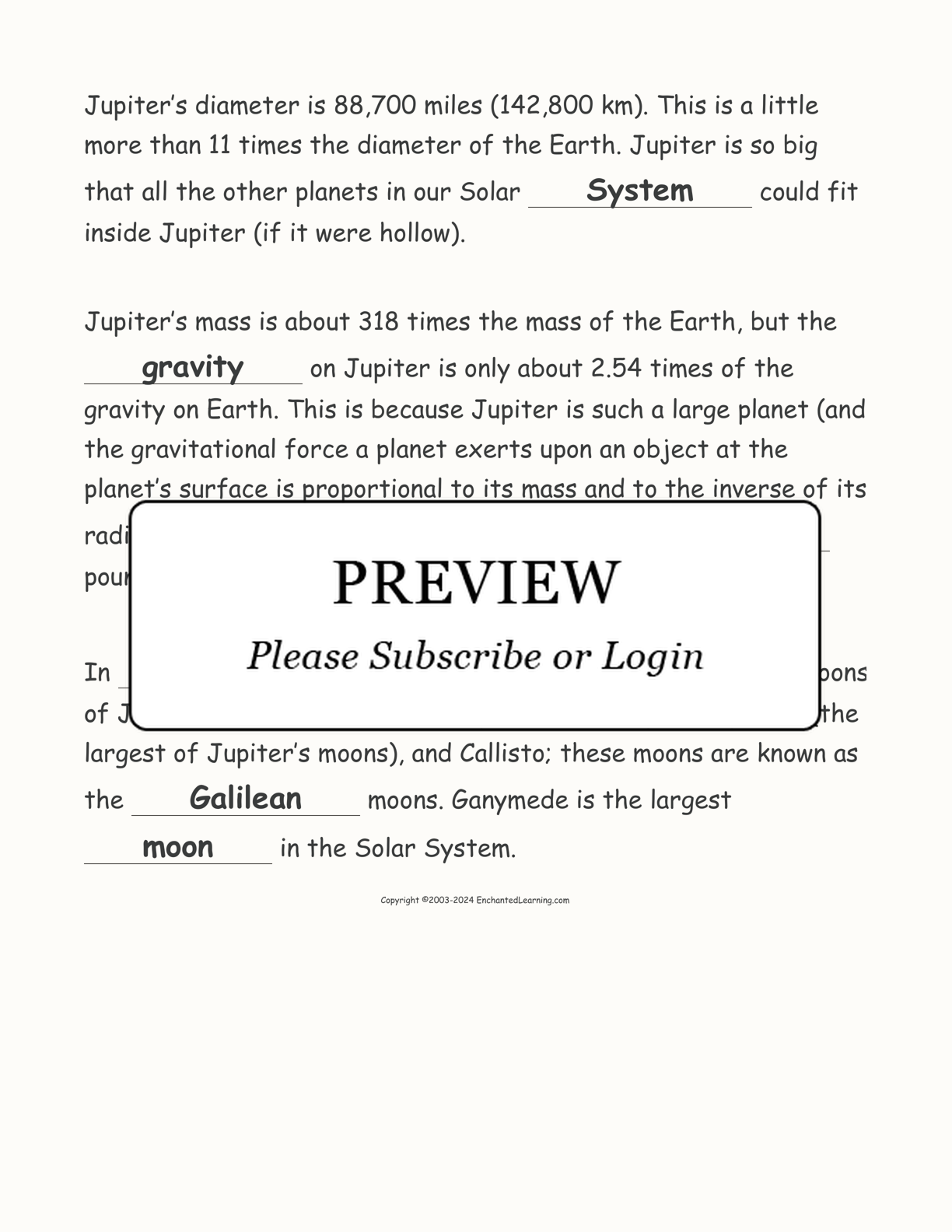
Answers |
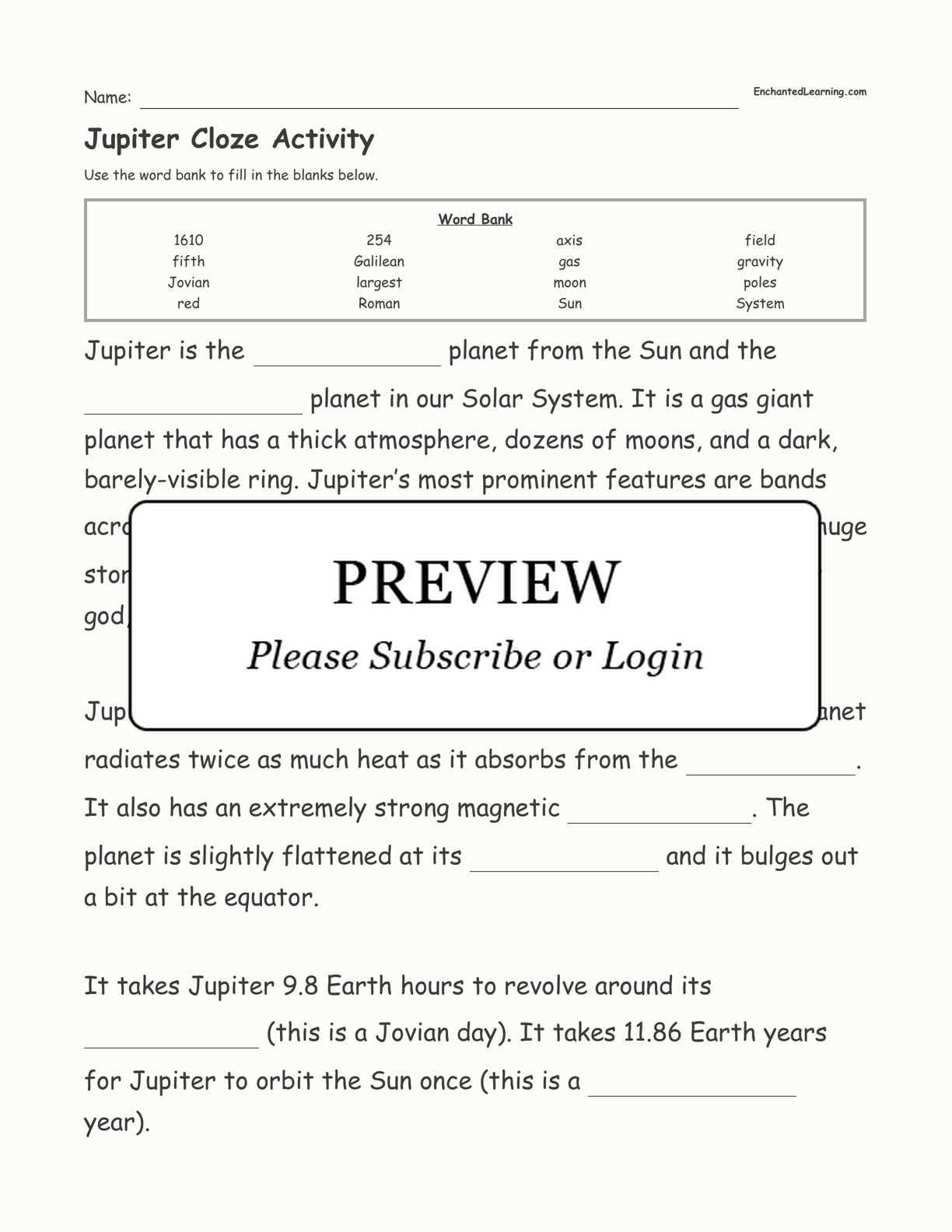
| red gas Jovian 1610 Galilean |
System largest poles 254 Sun |
moon fifth gravity axis field |
Jupiter is composed mostly of ________________________. This enormous planet radiates twice as much heat as it absorbs from the ________________________. It also has an extremely strong magnetic ________________________. The planet is slightly flattened at its ________________________ and it bulges out a bit at the equator.
It takes Jupiter 9.8 Earth hours to revolve around its ________________________ (this is a Jovian day). It takes 11.86 Earth years for Jupiter to orbit the Sun once (this is a ________________________ year).
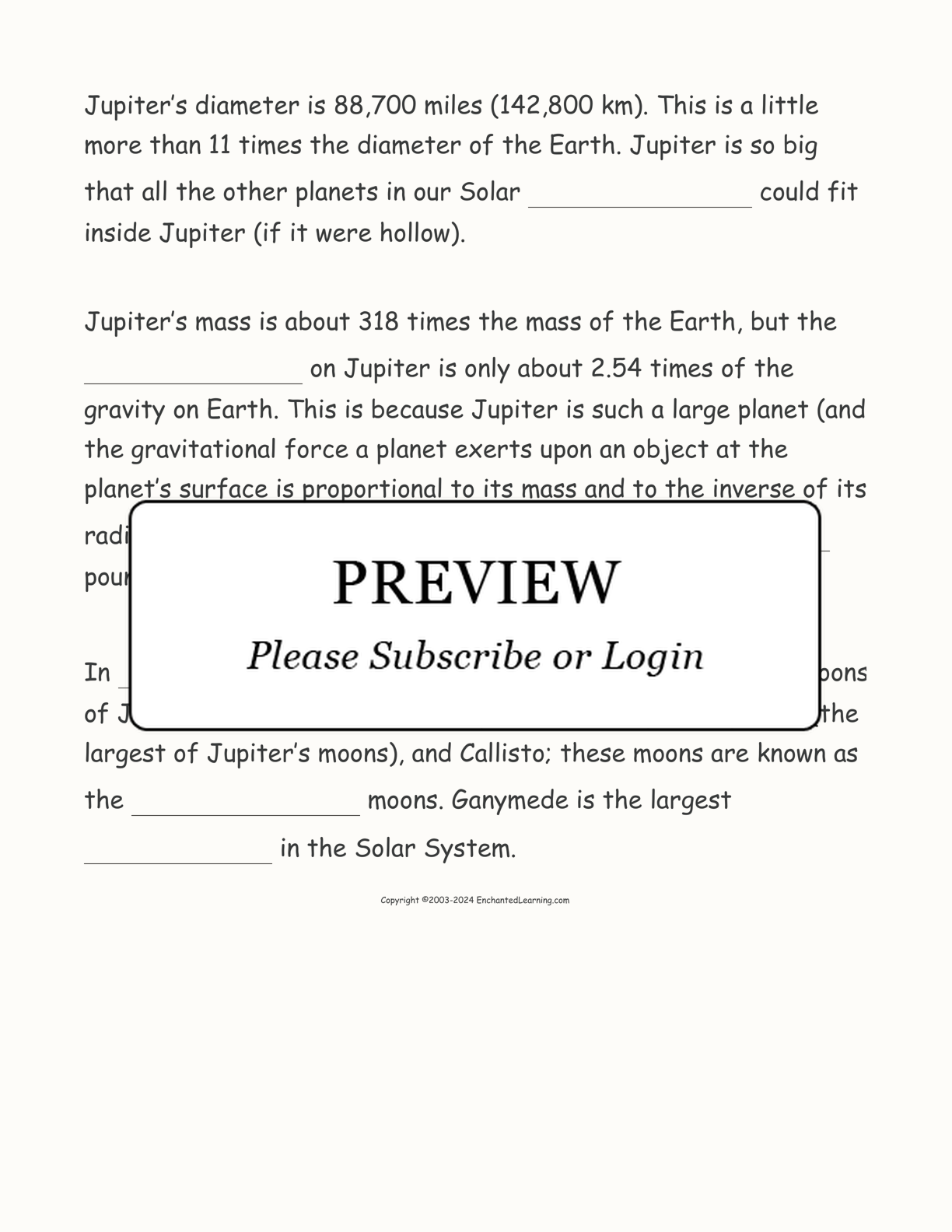
Jupiter's diameter is 88,700 miles (142,800 km). This is a little more than 11 times the diameter of the Earth. Jupiter is so big that all the other planets in our Solar ________________________ could fit inside Jupiter (if it were hollow).
Jupiter's mass is about 318 times the mass of the Earth, but the ________________________ on Jupiter is only about 2.54 times of the gravity on Earth. This is because Jupiter is such a large planet (and the gravitational force a planet exerts upon an object at the planet's surface is proportional to its mass and to the inverse of its radius squared). A 100-pound person would weigh ________________________ pounds on Jupiter.
In ________________________, Galileo first discovered the four largest moons of Jupiter, Io (which is volcanically active), Europa, Ganymede (the largest of Jupiter's moons), and Callisto; these moons are known as the ________________________ moons. Ganymede is the largest ________________________ in the Solar System.
|