





A battery is a device that converts chemical energy into electrical energy. Each battery has two electrodes, an anode (the positive end) and a cathode (the negative end). An electrical circuit runs between these two electrodes, going through a chemical called an electrolyte (which can be either liquid or solid). This unit consisting of two electrodes is called a cell (often called a voltaic cell or pile). Batteries are used to power many devices and make the spark that starts a gasoline engine.
Alessandro Volta was an Italian physicist invented the first chemical battery in 1800.
Storage batteries are lead-based batteries that can be recharged. In 1859, the French physicist Gaston Plante (1834-1889) invented a battery made from two lead plates joined by a wire and immersed in a sulfuric acid electrolyte; this was the first storage battery.
The dry cell is a an improved voltaic cell with a cylindrical zinc shell (the zinc acts as both the cathode and the container) that is lined with an ammonium chloride (the electrolyte) saturated material (and not a liquid). The dry cell battery was developed in the 1870s-1870s by Georges Leclanche of France, who used an electrolyte in the form of a paste.
Edison batteries (also called alkaline batteries) are an improved type of storage battery developed by Thomas Edison. These batteries have an alkaline electrolyte, and not an acid.
For more information on the battery, click here.
Henry Bell (1767-1830) was a Scottish engineer and inventor who built a steam-powered boat in 1812. His 12-foot (3.5-meter) steamboat, called the Comet, was the first commercially successful steamship in Europe. This boat regularly sailed between Greenock and Glasgow (Scotland) along the River Clyde. The Comet was the beginning of a revolution in navigation.

Braille is a coded system of raised dots that are used by the blind to read. Louis Braille (1809-1852) invented this system in 1829. Braille published “The Method of Writing Words, Music, and Plain Song by Means of Dots, for Use by the Blind and Arranged by Them,” and his method is still in use around the world today.
The first lawn mower was invented in 1830 by Edwin Beard Budding. Budding (1795-1846) was an engineer from Stroud, Gloucestershire, England. His reel mower was a set of blades set in a cylinder on two wheels. When you push the lawn mower, the cylinder rotates, and the blades cut the grass. Budding patented his lawn mower on August 31, 1830. Before his invention, a scythe was used (or sheep or other grazing animals were allowed to graze on the grass). The first reel lawn mower patent in the US (January 12, 1868) was granted to Amariah M. Hills, who formed the Archimedean Lawn Mower Co.

A metal can (or canister) for preserving food was invented in 1810 by a Peter Durand, of London, England. Metal cans (also called tins) could preserve food for a long period of time. To open a can, a person had to use a hammer and chisel; the can opener wasn’t invented for another 50 years.
The can opener was invented in 1858 by Ezra Warner of Waterbury, Connecticut, USA. Warner’s device used a lever and chisel. Until then, cans were opened using a hammer and chisel; the can opener was invented 50 years after the metal can was invented.
The can opener was improved in 1870 by William Lyman of West Meridian, Connecticut, USA. Lyman’s device used a rotating wheel and a sharp edge. His can opener only fit one size of can, and first had to pierce the center of the can.
The modern-day type of can opener (using a serrated wheel) was invented in 1925.
Thomas Davenport (July 9, 1802 -July 6, 1851) was an American blacksmith and inventor who established the first commercially successful electric streetcar. Davenport, from Vermont, invented an electric motor in 1834 and began a small electric railway in 1835. He patented a device for “Improvements in propelling machinery by magnetism and electromagnetism” in 1837 (his electric railway). Davenport later started a workshop in New York City, New York, and published a journal on electromagnetism (it was printed on a press that was powered by motors which he devised).

Sir Humphry Davy (1778-1829) was an English scientist who invented the first electric light in 1800. He experimented with electricity and invented an electric battery. When he connected wires from his battery to two pieces of carbon, electricity arced between the carbon pieces, producing an intense, hot, and short-lived light. This is called an electric arc. Davy also invented a miner’s safety helmet and a process to desalinate sea water. Davy discovered the elements boron, sodium, aluminum (whose name he later changed to aluminium), and potassium.
The first dishwasher was patented in 1850 by Joel Houghton; his machine was a hand-turned wheel that splashed water on dishes - unfortunately, it wasn’t very effective at washing dishes. The first working automatic dishwasher was invented by Mrs. Josephine Garis (W. A.) Cochran, of Shelbyville, Illinois, in 1889. Her dishwasher was a wooden tub with a wire basket in it - the dishes went in the basket, and rollers rotated the dishes. As a handle on the tub was turned, hot, soapy water was sprayed into the tub, cleaning the dishes. Cochran’s machine was first shown at the 1893 World’s Fair in Chicago, Illinois. At first, her machine was only bought by some restaurants and hotels. Cochran’s small company was eventually associated with the KitchenAid company. The dishwasher didn’t become widespread as a labor-saving machine until the 1960s.
Coenraad Johannes Van Houten (1801-1887) was a Dutch chemist and chocolate manufacturer who in 1828 invented the process that is used to turn roasted cacao beans (the source of chocolate) into cocoa powder (this process is now called Dutching, Dutch processing or alkalinisation). His method was an inexpensive way of removing much of the cocoa butter from the nib (center) of the beans, using a hydraulic press, and adding alkaline salts (potassium carbonate or sodium carbonate) so that the cocoa powder would mix readily with water or milk (the alkali neutralized the acidic chocolate). The resulting cocoa powder can be used to make chocolate milk and other delicacies.
Friedrich Wilhelm August Froebel (also written Fröbel) (1782-1852) was a German educator and educational reformer who invented the kindergarten (which means “garden of children”). He opened the first kindergarten in Bad Blankenburg (near Keilhau) in 1837. Froebel founded a kindergarten training school at Liebenstein, Germany in 1849. After some conflicts and mistaken charges of treason, the German government banned the establishment of kindergartens in 1851. In 1860, the government repealed the ban, and kindergartens re-opened (unfortunately, this was after Froebel’s death). Froebel’s kindergartens included pleasant surroundings, self-motivated activity, play, music, and the physical training of the child.

 Elias Howe (1819-1867) was American inventor who patented an improved sewing machine in 1846. His revolutionary machine used two separate threads, one threaded through the needle, and one in a shuttle; it was powered by a hand crank. A sideways-moving needle with its eye at one end would pierce the fabric, creating a loop of thread on the other side; a shuttle would then push thread through the loop, creating a tight lock stitch. Earlier sewing machines used only one thread and a chain stitch that could unravel. Howe’s business did not thrive. Others, like Isaac Singer made slight modifications in the machine and built successful businesses. Howe sued those who had infringed on his patent and won royalties on all machines sold (he was paid $5.00 for each sewing machine sold). Howe died the year his patent expired.
The first incandescent electric light was made in 1800 by Humphry Davy, an English scientist. He experimented with electricity and invented an electric battery. When he connected wires to his battery and a piece of carbon, the carbon glowed, producing light. This is called an electric arc.
Much later, in 1860, the English physicist Sir Joseph Wilson Swan (1828-1914) was determined to devise a practical, long-lasting electric light. He found that a carbon paper filament worked well, but burned up quickly. In 1878, he demonstrated his new electric lamps in Newcastle, England.
The inventor Thomas Alva Edison (in the USA) experimented with thousands of different filaments to find just the right materials to glow well and be long-lasting. In 1879, Edison discovered that a carbon filament in an oxygen-free bulb glowed but did not burn up for 40 hours. Edison eventually produced a bulb that could glow for over 1500 hours. The incandescent bulb revolutionized the world.

A kaleidoscope is a tube you look into that makes beautiful, colorful patterns using mirrors. The kaleidoscope was invented by the Scottish physicist Sir David Brewster (1781-1868); he patented the kaleidoscope in 1817.
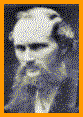
Lord Kelvin (William Thomson, 1824 - 1907) designed the Kelvin scale, in which 0 K is defined as absolute zero and the size of one degree is the same as the size of one degree Celsius. Water freezes at 273.16 K; water boils at 373.16 K.
For more information on Kelvin, click here.
Kindergarten (which means “garden of children”) was developed by Friedrich Wilhelm August Froebel (also written Fröbel) (1782-1852). Froebel was a German educator and educational reformer who opened the first kindergarten in Bad Blankenburg (near Keilhau) in 1837. Froebel founded a kindergarten training school at Liebenstein, Germany, in 1849. After some conflicts and mistaken charges of treason, the German government banned the establishment of kindergartens in 1851. In 1860, the government repealed the ban, and kindergartens re-opened (unfortunately, this was after Froebel’s death). Froebel’s kindergartens included pleasant surroundings, self-motivated activity, play, music, and the physical training of the child.
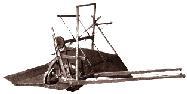
Cyrus Hall McCormick (February 15, 1809 - May 13, 1884) was an American inventor (of Irish descent) who developed the mechanical reaper. His new machine combined many of the steps involved in harvesting crops, greatly increased crop yields, decreased the number of field hands needed for the harvest, lowered costs, and revolutionized farming.
Cyrus Hall McCormick (February 15, 1809 - May 13, 1884) was an American inventor (of Irish descent) who developed the mechanical reaper. His new machine combined many of the steps involved in harvesting crops, greatly increased crop yields, decreased the number of field hands needed for the harvest, lowered costs, and revolutionized farming.
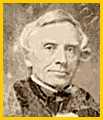
Samuel Finley Breese Morse (1791-1872) was an American inventor and painter. After a successful career painting in oils (first painting historical scenes and then portraits), Morse built the first American telegraph around 1835 (the telegraph was also being developed independently in Europe).
A telegraph sends electrical signals over a long distance, through wires. In 1830, Joseph Henry (1797-1878) made the first long-distance telegraphic device - he sent an electric current for over a mile on wire that activated an electromagnet, causing a bell to ring.
Morse patented a working telegraph machine in 1837, with help from his business partners Leonard Gale and Alfred Vail. Morse used a dots-and-spaces code for the letters of the alphabet and the numbers (Morse Code was later improved to use dots, dashes and spaces: for example E is dot, T is dash, A is dot-dash, N is dash-dot, O is dash-dash-dash, I is dot-dot, S is dot-dot-dot, etc.). By 1838, Morse could send 10 words per minute. Congress provided funds for building a telegraph line between Washington D.C. and Baltimore, Maryland, in 1843. Morse sent the first telegraphic message (from Washington D.C. to Baltimore) on May 24, 1844; the message was: “What hath God wrought?” The telegraph revolutionized long-distance communications.
Louis Pasteur (1822-1895) was a French chemist and inventor. Pasteur studied the process of fermentation, and postulated that fermentation was produced by microscopic organisms (other than yeast), which Pasteur called germs. He hypothesized that these germs might be responsible for some diseases. Pasteur disproved the notion of “spontaneous generation ” which stated that organisms could spring from nothing; Pasteur showed that organisms came form other, pre-existing organisms. Applying his theories to foods and drinks, Pasteur invented a heating process (now called pasteurization) which sterilizes food, killing micro-organisms that contaminate it.

The first rubber band was made in 1845 by Stephen Perry of the rubber manufacturing company Messers Perry and Co., in London, England. This rubber band was made of vulcanized rubber. Perry invented the rubber band to hold papers or envelopes together.
The first rubber band was made in 1845 by Stephen Perry of the rubber manufacturing company Messers Perry and Co., in London, England. This rubber band was made of vulcanized rubber. Perry invented the rubber band to hold papers or envelopes together.

The safety pin was invented by Walter Hunt in 1849. Hunt 1795-1859) patented the safety pin on April 10, 1849 (patent No. 6,281). Hunt’s pin was made by twisting a length of wire. Hunt invented the safety pin in order to pay a debt of $15; he eventually sold the rights to his patent for $400.
Antoine-Joseph (Adolphe) Sax (1814 - Feb. 4, 1894) was Belgian musical instrument manufacturer and musician (he played the clarinet) who invented the saxophone. Sax first exhibited his newly-invented woodwind instrument at the 1841 Brussels Exhibition, and patented it in 1846. Sax also invented the saxhorn (a family of bugles with 3 or 4 valves), which he first exhibited in 1844. For a printout on the saxophone, click here.
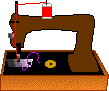
 The first functional sewing machine was invented by the French tailor Barthélemy Thimonnier in 1830. Other tailors feared for their livelihood, and burnt his workshop down. Elias Howe was American inventor who patented an improved sewing machine in 1846. Howe’s revolutionary machine used two separate threads, one threaded through the needle, and one in a shuttle; it was powered by a hand crank. A sideways-moving needle with its eye at one end would pierce the fabric, creating a loop of thread on the other side; a shuttle would then push thread through the loop, creating a tight lock stitch. Earlier sewing machines used only one thread and a chain stitch that could unravel. Howe’s business did not thrive. Others, like Isaac M. Singer made slight modifications in the machine and built successful businesses. Howe sued those who had infringed on his patent and won royalties on all machines sold (he was paid $5.00 for each sewing machine sold). Howe died the year his patent expired.
Samuel Finley Breese Morse (1791-1872) was an American inventor and painter. After a successful career painting in oils (first painting historical scenes and then portraits), Morse built the first American telegraph around 1835 (the telegraph was also being developed independently in Europe).
A telegraph sends electrical signals over a long distance, through wires. In 1830, Joseph Henry (1797-1878) made the first long-distance telegraphic device - he sent an electric current for over a mile on wire that activated an electromagnet, causing a bell to ring.
Morse patented a working telegraph machine in 1837, with help from his business partners Leonard Gale and Alfred Vail. Morse used a dots-and-spaces code for the letters of the alphabet and the numbers (Morse Code was later improved to use dots, dashes and spaces: for example E is dot, T is dash, A is dot-dash, N is dash-dot, O is dash-dash-dash, I is dot-dot, S is dot-dot-dot, etc.). By 1838, Morse could send 10 words per minute. Congress provided funds for building a telegraph line between Washington D.C. and Baltimore, Maryland, in 1843. Morse sent the first telegraphic message (from Washington D.C. to Baltimore) on May 24, 1844; the message was: “What hath God wrought?” The telegraph revolutionized long-distance communications.
Coenraad Johannes Van Houten (1801-1887) was a Dutch chemist and chocolate manufacturer who in 1828 invented the process that is used to turn roasted cacao beans (the source of chocolate) into cocoa powder (this process is now called Dutching, Dutch processing or alkalinisation). His method was an inexpensive way of removing much of the cocoa butter from the nib (center) of the beans, using a hydraulic press, and adding alkaline salts (potassium carbonate or sodium carbonate) so that the cocoa powder would mix readily with water or milk (the alkali neutralized the acidic chocolate). The resulting cocoa powder can be used to make chocolate milk and other delicacies.
Lucien Vidie was a French scientist who invented the aneroid barometer in 1843. A barometer is a device that measures air (barometric) pressure. It measures the weight of the column of air that extends from the instrument to the top of the atmosphere. There are two types of barometers commonly used today, mercury and aneroid (meaning “fluidless”). The aneroid barometer uses a spring balance instead of a liquid; it is easy to transport and easy to construct.
Eli Whitney (1765-1825) was an American inventor and engineer. Whitney invented the cotton gin and the idea of interchangeable parts. He patented the cotton gin, which revolutionized the cotton industry on March 14, 1794. The cotton gin is a machine that cleans cotton, removing its many seeds. Previously, this tedious job had been done by hand, using two combs. The cotton gin made much of the southern United States very rich, but cotton plantation owners rarely paid Whitney for the use of his invention, and Whitney went out of business. He never patented his later inventions (like his milling machine). Whitney also helped modernize the musket industry (and mass production in general) by introducing the idea of interchangeable parts in a manufacturing system.

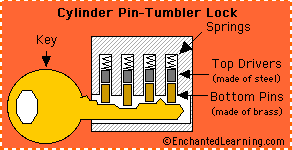 Linus Yale Jr. (1821-1868) was an American mechanical engineer and manufacturer who developed the cylinder pin-tumbler lock (and other key and combination locks). Yale’s father, Linus Yale, had invented an earlier pin-tumbler lock in 1848; the son’s lock used a smaller, flat key with serrated edges (like the ones we still use today). There is no connection between Linus Yale and Yale University.